Tuesday, May 09, 2017
Installing Ubuntu on Dell Inspiron 7559
Sharing the experience of successfully installing Ubuntu on the Dell Inspiron and lessons learned. First out the box setup the Dell and let it complete the Windows 10 installation (assuming you want to dual boot both as I have done).

While that is happening prepare your install USB stick for Ubuntu 16.04 LTS. Just as a note, I tried using Ubuntu 17.04 but had issues with the desktop locking up. Unity8 briefly worked but then it too froze. So I reverted back to 16.04 as the default. I suspect you can get 17.04 running if you put on the server version, and then manually install the desktop and configure the graphics and so forth and want to spend the extra time in resolving things.
Once the Windows 10 is complete (allow several hours for that) then you need to do 2 steps. First run the Windows disk defragment utility to compress down the file system. Then run the disk manager utility and shrink down the partition. I was able to shrink it to 250GB, leaving 760GB for installing Ubuntu.
Then with the Ubuntu boot USB inserted reboot and press F12 key and pick the USB boot. Choose the install Ubuntu option and the dual boot with Windows. Next connect to your network and proceed. Do not check the box that installs Third Party software, leave that out, it will interfere with the boot manager and you can manually add what you need once Ubuntu is installed.
Proceed to install Ubuntu and boot and log in.
Now you need to do these steps.
1) Set the graphics appearance so you can read and see things
2) Install latest LINUX kernel
3) Configure the NVidia graphics drivers
4) Configure the Intel Micro Code
5) Reboot and reset the graphics per 1) again.
5) Disable the Nouveau driver in the kernel
6) Reboot again and enjoy
First thing you will notice is that desktop items are really tiny. Click on the Ubuntu settings "gear wheel and spanner" icon. Pick 'Appearance' and set the Icon size to 64. Then return to All Settings and pick Display, and set the Scale for Menu and Title bars to 1.5 - now you should be good and can read things.
Second install the latest LINUX kernel, start by opening a terminal session (Ctrl+Alt+T) and create a temporary folder to get the components into by entering the following:
cd /tmp
mkdir kernel
cd /kernel
then follow the 4.9.9 setup instructions here.
Reboot, and what will happen is the shutdown will freeze with scrolling messages in text mode displayed. Just hard power off at that point holding the power switch down until it switches off. We are going to fix that last.
Once you are logged back into Ubuntu, in the launcher pick the Additional Drivers app. It will show you that NVidia and Micro code are missing.
To install those follow the instructions in this page for switching the graphics drivers and adding the micro code.
Reset your graphics again as in step 1.
Now we are ready to disable the Nouveau driver following these instructions (note; use gedit instead of the vim editor).
Reboot and that should be it. Your new shiny Ubuntu is ready to roll with smooth booting and shutdown and optimized GeForce GTX graphics.
Also you will notice that the touch screen functionality works for page scrolling and selecting text and menu options, which is a nice bonus.
To round things out enhance the audio ALSA support and Bluetooth control. For the audio install the Pulse audio equalizer and then from the Ubuntu Software center install the "Blue Man" Bluetooth Manager app. For more ideas see this Ubuntu handy list of things to install and configure plus these 38 ideas.
For comparison I ran the Geekbench 4 benchmarking from the terminal to ensure everything is running optimally with 8GB of memory installed. I then installed an additional 8GB to make 16GB total and reran, the result is noticeably better, so you may want to consider adding that extra memory; see the second image below.

And this is the Geekbench result for 16GB of memory installed which also tops the Multicore results for 16GB 7559 Inspirons on Geekbench overall. Kudos to Ubuntu 16.04 performance.

Going one better, I then installed a Samsung 250GB SSD and repeated all of the above to boot from the SSD (note: use the "Do something else" option in the Ubuntu installer - and manually configure the SSD swap space and root partition - see install 16.04 example here).
This gave a slightly better benchmark result as here.


While that is happening prepare your install USB stick for Ubuntu 16.04 LTS. Just as a note, I tried using Ubuntu 17.04 but had issues with the desktop locking up. Unity8 briefly worked but then it too froze. So I reverted back to 16.04 as the default. I suspect you can get 17.04 running if you put on the server version, and then manually install the desktop and configure the graphics and so forth and want to spend the extra time in resolving things.
Once the Windows 10 is complete (allow several hours for that) then you need to do 2 steps. First run the Windows disk defragment utility to compress down the file system. Then run the disk manager utility and shrink down the partition. I was able to shrink it to 250GB, leaving 760GB for installing Ubuntu.
Then with the Ubuntu boot USB inserted reboot and press F12 key and pick the USB boot. Choose the install Ubuntu option and the dual boot with Windows. Next connect to your network and proceed. Do not check the box that installs Third Party software, leave that out, it will interfere with the boot manager and you can manually add what you need once Ubuntu is installed.
Proceed to install Ubuntu and boot and log in.
Now you need to do these steps.
1) Set the graphics appearance so you can read and see things
2) Install latest LINUX kernel
3) Configure the NVidia graphics drivers
4) Configure the Intel Micro Code
5) Reboot and reset the graphics per 1) again.
5) Disable the Nouveau driver in the kernel
6) Reboot again and enjoy
First thing you will notice is that desktop items are really tiny. Click on the Ubuntu settings "gear wheel and spanner" icon. Pick 'Appearance' and set the Icon size to 64. Then return to All Settings and pick Display, and set the Scale for Menu and Title bars to 1.5 - now you should be good and can read things.
Second install the latest LINUX kernel, start by opening a terminal session (Ctrl+Alt+T) and create a temporary folder to get the components into by entering the following:
cd /tmp
mkdir kernel
cd /kernel
then follow the 4.9.9 setup instructions here.
Reboot, and what will happen is the shutdown will freeze with scrolling messages in text mode displayed. Just hard power off at that point holding the power switch down until it switches off. We are going to fix that last.
Once you are logged back into Ubuntu, in the launcher pick the Additional Drivers app. It will show you that NVidia and Micro code are missing.
To install those follow the instructions in this page for switching the graphics drivers and adding the micro code.
Reset your graphics again as in step 1.
Now we are ready to disable the Nouveau driver following these instructions (note; use gedit instead of the vim editor).
Reboot and that should be it. Your new shiny Ubuntu is ready to roll with smooth booting and shutdown and optimized GeForce GTX graphics.
Also you will notice that the touch screen functionality works for page scrolling and selecting text and menu options, which is a nice bonus.
To round things out enhance the audio ALSA support and Bluetooth control. For the audio install the Pulse audio equalizer and then from the Ubuntu Software center install the "Blue Man" Bluetooth Manager app. For more ideas see this Ubuntu handy list of things to install and configure plus these 38 ideas.
For comparison I ran the Geekbench 4 benchmarking from the terminal to ensure everything is running optimally with 8GB of memory installed. I then installed an additional 8GB to make 16GB total and reran, the result is noticeably better, so you may want to consider adding that extra memory; see the second image below.

And this is the Geekbench result for 16GB of memory installed which also tops the Multicore results for 16GB 7559 Inspirons on Geekbench overall. Kudos to Ubuntu 16.04 performance.

Going one better, I then installed a Samsung 250GB SSD and repeated all of the above to boot from the SSD (note: use the "Do something else" option in the Ubuntu installer - and manually configure the SSD swap space and root partition - see install 16.04 example here).
This gave a slightly better benchmark result as here.

Thursday, April 06, 2017
Acer Chromebook 14 running GalliumOS / Ubuntu Review
This is Part 2
having described how to setup GalliumOS on a Chromebook, now we
consider the overall user experience with the device and the Xfce4
desktop and applications.
Additionally by way
of comparison to a HP ProBook laptop running Microsoft Windows 7 and
equivalent experiences with common daily tasks. Including the value
proposition here in terms of the functionality enabled and the
overall cost and total ownership experience.

Comparing the HP
ProBook running Windows and Microsoft Office we see that the HP has a
dual core CPU 2.0GHz processor (3.0GHz burst mode) with 8GB of
memory. However with Windows loaded the available memory is 5GB. The
anti-virus software is disabled so that the significant 30% resource
drag it imposes is not a factor. The display on the HP is an older
1366x768 resolution, newer ones have 1080p displays. The battery life
is around 3.5 hours and the laptop weighs 5 pounds with battery. The
full size keyboard and touch pad give a professional typing feel.

The Chromebook with
GalliumOS and LibreOffice 5 suite has a quad core CPU 1.6GHz
processor with 4GB of memory. The processor has a burst mode of 2GHz
also. With the LINUX OS loaded there is 3.8GB of available memory.
The full HD 1080 display is professional quality device output
combined with the HDMI port. The battery life is at least 10 hours
and the device weighs 3 pounds. When using an external display
monitor battery life is significantly extended, 8 hours of use drains
only 4 to 5 hours of battery. The Chromebook keyboard is acceptable
for mobile use, I’m typing this travelling on the Metro Rail, but
for daily use an external wireless keyboard and mouse are the better
option.
For boot up time to
OS load and application menu activation then the Chromebook wins
hands down. Not only is Windows much slower to load anyway, but the
accessing for the USB 3.0 based resident OS is faster than the laptop
using the traditional disk hard drive. Similarly shutdown is
dramatically faster.
Next we move to
applications experience. For web browsing on the HP ProBook using IE
browser and a single tab it opens quickly and web sites load rapidly.
The dual code processor performs as expected. Similarly using FireFox
on the Chromebook is very comparible, quick loading and web site
navigation. When opening multiple saved tabs on both systems this
drags down performance, its not going to be an instant load, but a
wait period while all the various tabs are resolved. However, just
for dedicated web browsing one can just simply boot the Chromebook
natively into ChromeOS mode where it is optimized to provide the
fastest web experience.
The two Office
Suites are now very comparable. Microsoft Office is the industry
benchmark, but LibreOffice 5 (LO) is now almost identical. In fact
the LO Impress 5 may even be better than PowerPoint in many respects.
Similarly I recently used LO Base 5 to manage a database for 4,500
users in a government office complex. Importing and exporting data to
and from Excel spreadsheets, merging, updating and reporting. The SQL
commands in Base work well and being able to do all this from a
highly portable Chromebook in the field is ideal. LO Base also allows
data sharing across the suite to be enabled (called connection
pooling). This allows columns and rows to be seamlessly shared
between Calc and Base. This functionality is certainly on a par with
using Microsoft Access, while the SQL command option provides
significant additional power.
There are caveats,
the LO Base is held in memory, so as to optimize performance it
should be run standalone normally. Also, make sure to save
frequently, to clean up memory and make permanent record of the
latest database content. I should probably write a separate blog
entry on the how to and tricks and tips for LO Base operations. But
this does give a sense of what can be accomplished on the Chromebook.
What about Windows
applications generally? The Wine emulator works well in allowing a
range of standard Windows programs to run on LINUX. So your favourite
Windows programs can work over in GalliumOS too.
For software
development the OxygenXML editor uses Java and works on both machines
for supporting day to day content engineering. Other Java based
solutions like MindPlane, VLC video player, PDF tools and more also
work on both.
Moving on to using
multimedia. I was able to save videos filmed on an action camera in
full HD to the Chromebook. Each video is 0.5 GB (500Mb) in size. I
then used OpenShot to edit down and produce both YouTube and
Instagram video segments. This worked surprisingly quickly and only
took a few minutes to do the final production generation. I did
notice that all 4 CPU cores were being used 100% by OpenShot to
compute that rendering. Impressive resource sharing. On the HP
ProBook this is a more mixed experience. The Microsoft video editing
software is less competent, but of course you can install OpenShot on
Windows and then use that. I did not try that, but previously when I
have I always found OpenShot performs vastly better on LINUX.
On both systems
using Skype, Zoom or Google works well. The audio quality through the
USB microphone is exceptional and of course the built-in webcam
provides acceptable video too. The resolution of the Chromebook is a
1MB video chip the same as the 1MB on the ProBook.
Using the Bluetooth
on the Chromebook to connect to Sony headphones and then streaming
Pandora using the PinHos app is superb with A2DP support enabled. The
ProBook does not have Bluetooth, but obviously you can use a USB
Bluetooth adaptor to perform the same way.
Overall both systems
perform acceptably and are comparable in many respects. The newer
Acer Chromebook comes in ahead in display quality clearly and also
battery life where the low energy mobile chipset gives 3 times the
capability.
Value for dollars
spent gives the edge to the Chromebook for around $370 for the system
and the USB sticks, an USB + Ethernet extension hub and a simple
USB boom microphone. The HP ProBook starts at around $560 for the
older models. If I had a budget of $500 I would definitely look at
the Dell Chromebook with its superior specifications.
To round out this
review the results of the GeekBench CPU tests:
 Clearly the
Chromebook is not winning any performance awards compared to full CPU
machines.
Clearly the
Chromebook is not winning any performance awards compared to full CPU
machines.
However in class it
does well – for comparison to other Chromebooks see this review
(http://www.laptopmag.com/reviews/laptops/acer-chromebook-14).
What I like is the
portability, battery life and flexibility. Connecting an external
display and keyboard clearly covers off other reviewers needs. And
for commuting or classroom needs the Acer display and keyboard are
fine. Similarly running GalliumOS makes a huge difference in terms of
what can be accomplished on this machine. Hope this helps you make
informed decisions for your own needs.
Monday, April 03, 2017
Acer Chromebook 14 Dual Boot with LINUX / GalliumOS / Ubuntu
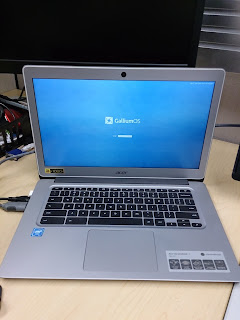
Following the success of running Ubuntu on an Intel Smart Stick, I realized I needed a portable solution for travel, along with more power for daily home desk use. Including developing software, editing media images and videos, and using office applications for work (including my own CAM Editor project).
After researching Chromebooks I settled on an Acer Chromebook 14 from my local MicroCenter store. The metal hard shell case, HD 1080p screen quality, light weight and great battery life all made this impressive and then quad-core CPU, 4GB of DRAM give it solid performance potential.
Using the Acer as a simple Chromebook and ChromeOS is a delight, super fast power up and log in to browsing. Perfect for those quick needs to hop on the Internet. Flip the lid, log in to Google account, surf.
Next is enabling the dual boot so you can also run serious desk applications, media tools and do software development. And of course work without being tethered to a WiFi connection.
There are several on-line resources setting out these steps (see below).
Essentially the steps can be summarized as:
- Enable ChromeOS Developer Mode boot up
Modify the Chromebook BIOS
Enable booting from a USB stick - Create a GalliumOS boot image USB stick
Boot from USB stick - Install GalliumOS on to your USB 128GB stick
Re-boot from USB 128GB stick and your brand new GalliumOS - Tailor and setup your new GalliumOS home
Fascinating Captain here provides the necessary overview instructions, but before you rush off to do all that, read my insights and the pitfalls to avoid. Plus use the tips and tricks and links here NOT those on Fascinating Captain (he is using a Toshiba not an Acer).
For the Acer Chromebook you need to install the Braswell GalliumOS which is tailored for Chromebook devices. The regular Ubuntu will not work. GalliumOS is also using the Xfce4 desktop and not Unity. Note that with Xfce4 you can make it look and use much of Unity functionality; more on that later.
Next thing to realize is that the ChromeOS is actually a parred down LINUX (GenToo) version produced by Google. What this means is that terminal mode is right there. Once you enable the developer mode, and boot to ChromeOS, you can now access command line bash, and then shell commands. This means you can download the Gallium boot ISO image and then use the Chromebook to create the bootable USB stick. The GalliumOS install page tells you how. It suggests the Etcher tool, but I used the LINUX dd command. It is vital you use the command exactly though e.g.
sudo dd bs=1M if=galliumos.iso of=/dev/sdb ; syncAgain this is slightly different from how Fascinating Captain has it. Notice also that to run the dd command you open the terminal window.
- Press [Ctrl+Alt+T] to get a ChromeOS terminal ("crosh") window
- At the prompt, enter
shell
Now you have the ISO boot stick ready, you need to enable dual booting. For dual booting on a Chromebook you should use the RW_LEGACY BIOS mod from the MrChromebox web site.
The way dual booting works is, the boot screen displays, and you then use Ctrl-L to boot LINUX, or Ctrl-D for ChromeOS. If you do nothing, it will time out, beep and boot to ChromeOS by default.

I have added the USB 3.0 port extender and Ethernet connector and the external HDMI cable in the picture here. That allows me to use my HD monitor and wireless keyboard and mouse. The HDMI works well with a VGA adapter if you need that to use your monitor or a projector.

I also have an external Samson "Go Mic" USB microphone for Skype and recording with using tools like Audacity. The Bluetooth works also with my Sony DR-BT50 headphones and Pandora and Google Play and A2DP fidelity.
So now you have things working, its time to move in and set up the "furniture and fittings" as you like it.

The keyboard mapping you can get to by pressing the ? search key and entering search term - keyboard. More on Chromebook keyboard here.
You can also setup Weather services from My-Weather-Indicator here. The default Weather Update in the Xfce4 panel does a nice job too.
I also added the Caffeine service from the Software library to prevent screen sleep during video play. In addition I ran the Startup app from the Settings and disabled a range of services that I do not need generally, including the timeout manager.
There's a big laundry list of software to install; naturally those are to you own preferences. Open the launcher and enter search term - software to see the software center.
Then here is my top dozen list:
1) Firefox browser. It is noticeably faster than Chromium (and do not install extensions in Chromium; it will crawl then).
2) LibreOffice Suite 5
3) Wine for running Windows software
4) Screenshot tool
5) Skype
6) VLC video player
7) Pithos for Pandora
8) Google Play desktop
9) Freeplane mindmap
10) GIMP editor
11) Kdiff3 compare
12) Audacity audio and OpenShot video
For many more tips, see this what to do guide. For online help see the GalliumOS community links. And don't forget to install latest updates using launcher and run the GalliumOS Update app. Then last but not least, purchase a spare USB 128GB stick and do a complete backup so you have an image.
Welcome to GalliumOS on your Acer Chromebook.
Here is a desktop screen shot of the Xfce4 launcher, Ubuntu theme and nautilus file manager open.

Here is a of screen shot of several desktop items open and the system performance monitor.

Thursday, June 30, 2016
Intel Compute Stick and Ubuntu review - the new wave in computing systems?
My brother recently sent over an Intel Compute Stick - model STK1A32SC as a birthday gift.


Addendum:
The USB ports are slightly wider, probably a design decision by Intel to avoid stress on the connectors on the board inside the Stick. This does make the connections looser than desirable so to solve this I install a shim snipped off the edge of a store keyring customer loyalty card as it is the right thickness. With this in the USB connection for the USB hub is tight and solid, I just leave the hub connected permanently.
Here is what the shim looks like on the USB connector.

Of course this is somewhat a geek toy, especially the bare stick without the OS installed.
You will need a bootable USB flash drive with the Ubuntu image installed - and the Atom CPU version. Full instructions and download are here. ARMed (geek joke) with this - you are ready to install and enjoy Ubuntu 64bit on this system. I installed a 128Gb MicroSD card into the Compute Stick also. Along with plugging in an old USB keyboard to do the initial install. Then once Ubuntu was running, I plugged in a Logitech USB with wireless keyboard and mouse.
Everything then works wonderfully, LibreOffice 5, Skype, NetFlix (install Chrome browser) and YouTube along with Pandora. Plus Microsoft Office365 and Outlook works perfectly in FireFox. Along with my own Java based Eclipsed XML editor project (http://www.cameditor.org) Ubuntu 64bit distribution.
For Skype I setup the Logitech C320 Web Cam. There's Ubuntu community help for this, it is a little fiddly to get Skype using the microphone and video but it does and the quality to amazing (apt-get install pavucontrol and use that resolve). One caveat, the WiFi adapter is not the most powerful (although Intel improved this), so you do need a strong WiFi signal near by at home or office (it did work perfectly with my Sony Xperia phone running as a HotSpot with T-Mobile however). Also I bought a 3 foot HDMI cable so signal is not blocked by the Stick sitting behind the screen display.
Next I used the Bluetooth to connect to my Sony DR-BT50 high fidelity headphones and played Pandora - this is like having satellite XM radio for free.
I'm using a Vizio HD 19" display with HDMI port to round out the system.
Here is what the Compute Stick looks like (with mouse for size comparison), with the HDMI short cord plugged into the TV monitor. From left to right on the Compute Stick edge are USB3 with Web cam, the USB2 with Logitech micro USB wireless keyboard/mouse dome and then the micro USB power cord plug.
Here is what the Compute Stick looks like (with mouse for size comparison), with the HDMI short cord plugged into the TV monitor. From left to right on the Compute Stick edge are USB3 with Web cam, the USB2 with Logitech micro USB wireless keyboard/mouse dome and then the micro USB power cord plug.

And then below is the complete system, with the monitor display, full size keyboard, Web cam and Bluetooth headphones. And best of all I had all these items already, so nothing to purchase.
When you look at this you realize that a system like this would have cost double a few years ago. The processing power in the quad core Atom CPU combined with the 2Gb of main memory is impressive. The boot up speed from the MicroSD card is a few seconds and the shutdown is instantaneous.

I am writing this blog now on the system and this has now replaced my old Dell E6410 laptop as my main daily solution and so far the performance is very comparable for daily tasks. I am adding a USB3 1TB external drive next, so I can synchronize my work Home folders, and also have movies to play, and my whole archive of work materials.
The portability is impressive. Compared to lugging around the laptop. What I like though is that this is a componentized computing solution.
When Intel come out with the next Compute Stick I can simply install the latest Ubuntu OS and plug that system into the same set of peripherals and roll forward. Or if one component fails, I simply replace that.
The folks at Intel need to do more marketing around this flexibility and power that they are enabling. Here is the system monitor showing the analytics when running FireFox browser with multiple sites open, include OutLook365, along with using the OxygenXML development IDE, a Java application, along with an open spreadsheet in Libre Office 5.


Business is also paying attention; at work they realize this is a serious option compared to giving new employees laptops. And even more so for travelling and flying around. Just plug into the business center display or room TV at the hotel, or to present to a client, their A/V system HDMI port. Then secretarial staff, e.g. in hospitals and nursing homes, this is a cheap and effective option compared to desktop computers, or even for patients rooms, the ability to stream NetFlix, Pandora and TV and Radio stations.
Plus of course for remote monitoring device systems, where you can use Ubuntu to connect to devices around the home or facility.
All around this is superb functionality; like having a Raspberry Pi on steroids.
Addendum:
The USB ports are slightly wider, probably a design decision by Intel to avoid stress on the connectors on the board inside the Stick. This does make the connections looser than desirable so to solve this I install a shim snipped off the edge of a store keyring customer loyalty card as it is the right thickness. With this in the USB connection for the USB hub is tight and solid, I just leave the hub connected permanently.
Here is what the shim looks like on the USB connector.

Wednesday, October 21, 2015
Quick review of Schwalbe One 451 road tires
The Schwalbe One are the replacement for the Ultremo ZX which I've ridden for 4,000+ miles and over a year now.
So how do the One tires compare? First impressions very good, very equal on weight and feel in your hand, and depth of rubber around the heel of the tire where you need it most.
The ZX side wall had a tendency to shred strands of cotton, but the new One shows no signs of that.
Schwalbe claim the rolling resistance is lower on the One tires. Certainly these One's are just as fast as the ZX, maybe a tad faster. I rode them for the first time in Richmond for the UCI event and did the Cary Street bikes group ride for 40 miles on my Bike Friday, averaging just over 20mph and several segments we were averaging in the high 25+ mph. So I am convinced there - these tires are blazing quick.
Durability seems to be improved also, I have ridden close to 350 miles now on the tires, variety of road quality and trails and they are holding up well.
I keep them at around 110psi inflation with regular 451 inner tubes and that provides a excellent ride quality.
Overall I would give these new Schwalbe One tires a firm and positive recommend. Worth the asking price, and looking forward to another 4,000 miles ridden on these tires and my Bike Friday.
So how do the One tires compare? First impressions very good, very equal on weight and feel in your hand, and depth of rubber around the heel of the tire where you need it most.
The ZX side wall had a tendency to shred strands of cotton, but the new One shows no signs of that.
Schwalbe claim the rolling resistance is lower on the One tires. Certainly these One's are just as fast as the ZX, maybe a tad faster. I rode them for the first time in Richmond for the UCI event and did the Cary Street bikes group ride for 40 miles on my Bike Friday, averaging just over 20mph and several segments we were averaging in the high 25+ mph. So I am convinced there - these tires are blazing quick.
Durability seems to be improved also, I have ridden close to 350 miles now on the tires, variety of road quality and trails and they are holding up well.
I keep them at around 110psi inflation with regular 451 inner tubes and that provides a excellent ride quality.
Overall I would give these new Schwalbe One tires a firm and positive recommend. Worth the asking price, and looking forward to another 4,000 miles ridden on these tires and my Bike Friday.
Sunday, January 04, 2015
Using OpenShot with Instagram - Guide for Loading Pre-Recorded Video to Instagram
While uploading still pictures to Instagram from your DSLR is a straightforward process, doing the same with video clips is entirely another matter.
Video has a whole raft of parameters associated with it, and Instagram is rather picky on what it will accept. In fact it has to be precisely formatted for Instagram use.
This is a quick guide to explain how to use the OpenShot video editor to achieve reliable uploads.
You can download and install OpenShot here. You can also find a wealth of tutorials and how to videos. My focus here is just on using OpenShot for Instagram.
First thing is to open your video clip in OpenShot and then trim the length to be 15 seconds or less. I also add a Fade of Fast In and Fast Out - so views smoothly.
Then you are ready to Export your video. Before selecting the Export menu option however the first step is to go to "Edit / Preferences" and select the "Profiles" tab, then "Manage" and click the "+" to Add a new Profile.
Here is a screen shot of what you need to complete there:

Notice the format is 640 x 640, 1 : 1 aspect ratio. Don't worry if your original video is not in that format, OpenShot will handle all the export formatting for you.
Next "Save" the new template, and proceed to the "File / Export" option.
Now you need to pick these options for the Video and Audio formatting:

Every single setting is crucial. The only one I have found is flexible is the number of audio channels. 2 appears to work, although Instagram themselves recommend just 1 channel.
Complete the settings; save your video clip. Then you need to transfer the clip to your mobile device so you can use the Instagram App to publish it. The clips are less than 10Mb is size so I simply email it to my mobile device email account, download it there, and then open Instagram.
Then once there, click the Camera button to take a picture, switch to video mode, and then click the GRID BOX of dots to the right. This will allow you to browse and select your downloaded video. Then proceed as normal to publish to Instagram.
Video has a whole raft of parameters associated with it, and Instagram is rather picky on what it will accept. In fact it has to be precisely formatted for Instagram use.
This is a quick guide to explain how to use the OpenShot video editor to achieve reliable uploads.
You can download and install OpenShot here. You can also find a wealth of tutorials and how to videos. My focus here is just on using OpenShot for Instagram.
First thing is to open your video clip in OpenShot and then trim the length to be 15 seconds or less. I also add a Fade of Fast In and Fast Out - so views smoothly.
Then you are ready to Export your video. Before selecting the Export menu option however the first step is to go to "Edit / Preferences" and select the "Profiles" tab, then "Manage" and click the "+" to Add a new Profile.
Here is a screen shot of what you need to complete there:
Notice the format is 640 x 640, 1 : 1 aspect ratio. Don't worry if your original video is not in that format, OpenShot will handle all the export formatting for you.
Next "Save" the new template, and proceed to the "File / Export" option.
Now you need to pick these options for the Video and Audio formatting:
Every single setting is crucial. The only one I have found is flexible is the number of audio channels. 2 appears to work, although Instagram themselves recommend just 1 channel.
Complete the settings; save your video clip. Then you need to transfer the clip to your mobile device so you can use the Instagram App to publish it. The clips are less than 10Mb is size so I simply email it to my mobile device email account, download it there, and then open Instagram.
Then once there, click the Camera button to take a picture, switch to video mode, and then click the GRID BOX of dots to the right. This will allow you to browse and select your downloaded video. Then proceed as normal to publish to Instagram.
Monday, October 06, 2014
Understanding the Two Halves of America
http://www.nytimes.com/interactive/2014/10/02/magazine/mag-oil-lawsuit.html - and seeing how the wheels of government are manipulated and twisted and turned. All the various interests that are conflicted.
The article is long, but very well written. Portraits of the characters are delightfully drawn. Behind it all is the reality but beyond that is the sense that changing all this is desperately difficult, and that the lessons are now learned. History is repeating itself already with the frightening tar sands escapades.
The love affair and addiction to oil and everything it brings is too alluring.
The article is long, but very well written. Portraits of the characters are delightfully drawn. Behind it all is the reality but beyond that is the sense that changing all this is desperately difficult, and that the lessons are now learned. History is repeating itself already with the frightening tar sands escapades.
The love affair and addiction to oil and everything it brings is too alluring.
Tuesday, December 31, 2013
Trek Cronus CX Pro Gary Fisher 2013 (and Ultimate) Bike Review
Sharing my initial thoughts here on the Trek Cronus CX Pro 2013 (Gary Fisher) bike that I recently acquired through eBay. I have been doing CX racing now for two years, initially racing my own custom build bike using a cheap Nashbar frame and carbon forks along with parts from my garage and from eBay that works surprisingly well. The Stan's NoTubes wheels with tubeless Clement tires are an essential component, however the Cronus CX is obviously in a whole another league.
Buying from eBay is clearly dependent on your knowledge of the current bike scene and confidence in using eBay. More reputable dealers and sellers provide lots of detailed pictures in high resolution and good lighting of the bike, plus history and trim of the bike. And you can gauge prices from sites like the Bicycle Blue Book. The listing for the Trek Gary Fisher Cronus CX Pro 2013 is reflective of the current market on eBay.
So now to the bike itself. The one I have is significantly upgraded from the base CX Pro model to equivalent with the Ultimate trim. Including the Ultegra CX70 crankset, Ultegra shifters, TRP CX9 brakes and Look carbon pedals along with the Stan's NoTubes 340 wheelset and Clement tires. Then I also found a second set of NoTube 340's with DT Swiss hubs and tubeless Hutchinson 700x23 road race tires on eBay. Equipped with these wheels the Trek Cronus CX Pro weighs exactly 17 lbs kerb weight ready to ride. If you wanted sub-17lb bragging rights then swap the stock Bontrager stem with something 30 grams lighter. I am 6' 2" and the 56cm frame fits perfectly with the saddle height and angle extremely comfortable - almost embarrassingly nice - along with the reach onto the hoods and bars and cockpit overall. Note that I put the stock Bontrager wheelset and QR levers and CX0 tires back on my old Nashbar ride. The CX0 tires are actually very good, but the stock wheels are well, stock wheels, heavy and average, pushing the total kerb weight up to 18.7 lbs with the CX0 tires and tubes.
So the idea is with the way I have the Cronus CX Pro setup this is a "do it all" bike - cyclocross for three months of the year, some single trail off road riding in the winter months, and then swap the wheelsets and switch to a mean quick road machine for shorter summer rides and training runs. I've tried it on my indoor training rollers too and 80rpm and 27mph on zero resistance were effortless to spin (riding is not supposed to be this easy). Also because you can fit fenders and bottle cages, this would make an ideal commuter bike too. I have on order a 50T front chain ring also, as the stock CX70 crankset is a 46T x 36T ratio, so the 50T will give some more cruising and top speed on the road. One other thing I notice with the wide frame and clearances, this bike is super easy to wipe down and keep nicely clean from normal road use.
The most important aspect of course is how does the Cronus CX ride? This is my first Trek bike and I must say I am very impressed. I have a stable of other bikes but equipped with the tubeless Hutchinson tires this Cronus CX rides smoother than any other, including my steel framed touring bikes.The acceleration and cornering are phenomenal, this bike flat out responds and flies. Rock solid at speed in and through corners. If you are into logging rides on Strava this road setup has serious KOM potential on shorter hilly and stop go sections with turns. Plus the CX frame smooths out those rough road sections taking the jarring and bumping out. I already set one new KOM on my first ride on the Cronus where the road rattled the heck out of you on my trusty Kestrel carbon road racer but the Cronus took it in stride. Now overall of course it is a cyclocross frame and geometry so I'm not expecting to push 50 mile and 100 mile rides, but 20 to 30 miles seems very doable.
I think Trek and Gary Fisher have this spot on. If you drop this much on a bike you want to use it way more than just a few races in the fall during cyclocross season. I'm planning to put some serious miles on this bike and it definitely gets you excited to get out there on the road and see what it can do and rewards with great road feel, cornering and ability to sprint and go under power and also mix it up on varied terrain.
I will provide more updates here as time progresses and I get more experience. Overall though if you are looking at the Cronus CX as a possibility then I don't have anything bad to say at this point; put the Cronus on your check list. Here is what the BikeRadar Cronus CX Pro 2012 review had to say too, and then this review from the UK of the Cronus CX Pro 2013 model (and nice picture gallery views/details), but the most comprehensive review is here from Road.cc magazine on Cronus CX Pro 2012.
Addendum
I just did my New Years 2014 ride with the local bike fraternity and get back home to find that Trek has released the new Boone CX as the top dog badass CX race machine. See the CX magazine Boone news splash.
Ah well, there is always the newer model out there; however looks like they are continuing the Cronus CX as it fills a more all-round space than the Boone, and priced and equipped accordingly.
Further Thoughts
Spent last two days charging around throwing Cronus at local ride courses and the more I spend time on this bike, the more I'm impressed. Today I rode through our local park on rough wooden bridges and trestles - usually this is a bone and teeth jarring past time on my Kestrel carbon road bike with 120psi slick tires - but the Cronus glides over these with barely a rumble - tubeless 90psi rubber and OCLV frame and consequently averages 3 mph faster with no effort. Crazy impressive. Then a couple of tough hill sections - Cat 4 romps on Strava and I better both my best times and set one KOM. The Cronus just invites you to throw the power down and then get out the saddle and crank and rewards that effort accordingly. But what about the raw sprint speed? Well I put on a 50T crank ring and so top speed is only a whisker under my Kestrel, but the overall speed is better as the climbing is so much improved and of course cornering and descending is rock solid. Quicker, smoother, more agile. Not bad at all for what is billed as a CX bike.
If the new Trek Boone is better than this then that has to be one heck of a ride.
For comparison of the bike specifications see this page on the Boone. Interestingly "Compared to Cronus, Boone has a lower head tube, longer top tube, steeper seat angle, lower BB, and shortened chainstays. This makes for a more forward, race-oriented riding position." Probably means the Cronus is easier on the body when riding on road instead. The road.cc review link above has a good assessment of the Cronus cockpit configuration and ride setup.
Buying from eBay is clearly dependent on your knowledge of the current bike scene and confidence in using eBay. More reputable dealers and sellers provide lots of detailed pictures in high resolution and good lighting of the bike, plus history and trim of the bike. And you can gauge prices from sites like the Bicycle Blue Book. The listing for the Trek Gary Fisher Cronus CX Pro 2013 is reflective of the current market on eBay.
So now to the bike itself. The one I have is significantly upgraded from the base CX Pro model to equivalent with the Ultimate trim. Including the Ultegra CX70 crankset, Ultegra shifters, TRP CX9 brakes and Look carbon pedals along with the Stan's NoTubes 340 wheelset and Clement tires. Then I also found a second set of NoTube 340's with DT Swiss hubs and tubeless Hutchinson 700x23 road race tires on eBay. Equipped with these wheels the Trek Cronus CX Pro weighs exactly 17 lbs kerb weight ready to ride. If you wanted sub-17lb bragging rights then swap the stock Bontrager stem with something 30 grams lighter. I am 6' 2" and the 56cm frame fits perfectly with the saddle height and angle extremely comfortable - almost embarrassingly nice - along with the reach onto the hoods and bars and cockpit overall. Note that I put the stock Bontrager wheelset and QR levers and CX0 tires back on my old Nashbar ride. The CX0 tires are actually very good, but the stock wheels are well, stock wheels, heavy and average, pushing the total kerb weight up to 18.7 lbs with the CX0 tires and tubes.
So the idea is with the way I have the Cronus CX Pro setup this is a "do it all" bike - cyclocross for three months of the year, some single trail off road riding in the winter months, and then swap the wheelsets and switch to a mean quick road machine for shorter summer rides and training runs. I've tried it on my indoor training rollers too and 80rpm and 27mph on zero resistance were effortless to spin (riding is not supposed to be this easy). Also because you can fit fenders and bottle cages, this would make an ideal commuter bike too. I have on order a 50T front chain ring also, as the stock CX70 crankset is a 46T x 36T ratio, so the 50T will give some more cruising and top speed on the road. One other thing I notice with the wide frame and clearances, this bike is super easy to wipe down and keep nicely clean from normal road use.
The most important aspect of course is how does the Cronus CX ride? This is my first Trek bike and I must say I am very impressed. I have a stable of other bikes but equipped with the tubeless Hutchinson tires this Cronus CX rides smoother than any other, including my steel framed touring bikes.The acceleration and cornering are phenomenal, this bike flat out responds and flies. Rock solid at speed in and through corners. If you are into logging rides on Strava this road setup has serious KOM potential on shorter hilly and stop go sections with turns. Plus the CX frame smooths out those rough road sections taking the jarring and bumping out. I already set one new KOM on my first ride on the Cronus where the road rattled the heck out of you on my trusty Kestrel carbon road racer but the Cronus took it in stride. Now overall of course it is a cyclocross frame and geometry so I'm not expecting to push 50 mile and 100 mile rides, but 20 to 30 miles seems very doable.
I think Trek and Gary Fisher have this spot on. If you drop this much on a bike you want to use it way more than just a few races in the fall during cyclocross season. I'm planning to put some serious miles on this bike and it definitely gets you excited to get out there on the road and see what it can do and rewards with great road feel, cornering and ability to sprint and go under power and also mix it up on varied terrain.
I will provide more updates here as time progresses and I get more experience. Overall though if you are looking at the Cronus CX as a possibility then I don't have anything bad to say at this point; put the Cronus on your check list. Here is what the BikeRadar Cronus CX Pro 2012 review had to say too, and then this review from the UK of the Cronus CX Pro 2013 model (and nice picture gallery views/details), but the most comprehensive review is here from Road.cc magazine on Cronus CX Pro 2012.
Addendum
I just did my New Years 2014 ride with the local bike fraternity and get back home to find that Trek has released the new Boone CX as the top dog badass CX race machine. See the CX magazine Boone news splash.
Ah well, there is always the newer model out there; however looks like they are continuing the Cronus CX as it fills a more all-round space than the Boone, and priced and equipped accordingly.
Further Thoughts
Spent last two days charging around throwing Cronus at local ride courses and the more I spend time on this bike, the more I'm impressed. Today I rode through our local park on rough wooden bridges and trestles - usually this is a bone and teeth jarring past time on my Kestrel carbon road bike with 120psi slick tires - but the Cronus glides over these with barely a rumble - tubeless 90psi rubber and OCLV frame and consequently averages 3 mph faster with no effort. Crazy impressive. Then a couple of tough hill sections - Cat 4 romps on Strava and I better both my best times and set one KOM. The Cronus just invites you to throw the power down and then get out the saddle and crank and rewards that effort accordingly. But what about the raw sprint speed? Well I put on a 50T crank ring and so top speed is only a whisker under my Kestrel, but the overall speed is better as the climbing is so much improved and of course cornering and descending is rock solid. Quicker, smoother, more agile. Not bad at all for what is billed as a CX bike.
If the new Trek Boone is better than this then that has to be one heck of a ride.
For comparison of the bike specifications see this page on the Boone. Interestingly "Compared to Cronus, Boone has a lower head tube, longer top tube, steeper seat angle, lower BB, and shortened chainstays. This makes for a more forward, race-oriented riding position." Probably means the Cronus is easier on the body when riding on road instead. The road.cc review link above has a good assessment of the Cronus cockpit configuration and ride setup.
Thursday, December 12, 2013
Biking YouTube video channel - 20,000 views and counting
The rise of modern biking continues driven by technology changes and the level of the machines now available at reasonable price points.
My little small corner and contribution to the biking world has now passed the 20,000 views milestone, something I never even thought about when I posted the first video on indoor roller riding made easier: http://www.youtube.com/user/MDBikerDude
A little tribute to sweat, toil and fun on wheels with cranks and gears.
My little small corner and contribution to the biking world has now passed the 20,000 views milestone, something I never even thought about when I posted the first video on indoor roller riding made easier: http://www.youtube.com/user/MDBikerDude
A little tribute to sweat, toil and fun on wheels with cranks and gears.


